







Regular tolerance and reverse tolerance move in opposite directions. With regular tolerance, you need higher doses to get the same effect because your body adapts through receptor desensitization and faster metabolism. With reverse tolerance, you need smaller doses because you’ve become more sensitive, often signaling liver or kidney damage that slows breakdown. That heightened sensitivity makes reverse tolerance more dangerous, since low amounts can trigger severe reactions. Here’s what’s driving each pattern.
Key Takeaways
- Regular tolerance means reduced drug response after repeated use, requiring higher doses to achieve the same effect.
- Reverse tolerance means increased sensitivity over time, so smaller doses produce stronger reactions.
- Regular tolerance develops from neuroadaptation, receptor desensitization, and metabolic enzyme induction that speeds drug breakdown.
- Reverse tolerance often signals organ damage, especially liver impairment that slows metabolism and causes substances to accumulate.
- Reverse tolerance is considered more dangerous because low doses can trigger severe reactions mimicking overdose.
What is the difference between reverse tolerance and regular tolerance
Reverse tolerance and regular tolerance move in opposite directions. With regular tolerance, or desensitization, your body adapts to repeated exposure, so you’ll need higher doses to achieve the same effect. This reflects neuroadaptation at the receptor level, including receptor desensitization and metabolic enzyme induction.
Reverse tolerance, also called inverse tolerance or tolerance reversal, works the opposite way. You become more sensitive to a substance over time, so smaller doses produce stronger reactions. This sensitization often signals organ system failure, particularly liver damage that impairs metabolism.
The distinction between reverse vs regular tolerance is clear: tolerance decreases drug potency and requires escalating amounts, while sensitization increases potency and demands decreasing amounts. One indicates neuroadaptation, the other frequently indicates underlying pathology.
What is regular (built-up) drug tolerance
Regular (built-up) drug tolerance is a physiological process in which your body adapts to repeated drug use by reducing its response, forcing you to take higher doses to achieve the same effect. It is also called desensitization or habituation. It develops as your organ systems adapt through neuroadaptation at the receptor level, including receptor desensitization and metabolic enzyme induction. As the drug’s potency decreases, you’ll need escalating amounts to reproduce the original psychoactive effect. Reverse tolerance and weed shows why smaller doses can hit harder over time, navigating the implications of cannabis consumption.
Regular tolerance is gradual and common, and the DSM-5 classifies it as one of 11 diagnostic criteria for substance use disorder. Unlike the reverse tolerance meaning, which involves heightened sensitivity, regular tolerance signals your body’s diminishing reaction to consistent, repeated exposure over time.
What is reverse tolerance and why is it called inverse tolerance

Reverse tolerance is a phenomenon where you need less of a substance to feel its effects, not more. Also called inverse tolerance or sensitization, it means the same dose produces a much stronger reaction than before. Your body becomes more sensitive over time, not less. Learning reverse tolerance facts shows why smaller doses can bring on stronger effects, giving you the knowledge to make safer, healthier choices.
It’s named “inverse tolerance” because it stands in direct opposition to standard desensitization:
- Direction of dosing: You require decreasing amounts, not increasing ones, to achieve the original effect.
- Potency shift: The drug’s potency effectively increases rather than diminishes.
- Underlying cause: It often signals organ system failure, particularly liver damage, rather than neuroadaptation.
Recognizing this reversal matters clinically, since heightened sensitivity can mimic overdose symptoms in long-term users.
How do the two types of tolerance work in opposite directions
The two types of tolerance work in opposite directions because they push your body’s response the opposite way, even though both stem from repeated drug exposure. With regular tolerance, you’ll need increasing doses because neuroadaptation, receptor desensitization and enzyme induction, diminishes the drug’s potency over time. With reverse tolerance, you’ll need decreasing doses because your body becomes hypersensitive, often due to organ damage that impairs metabolism.
| Feature | Regular Tolerance | Reverse Tolerance |
|---|---|---|
| Dose direction | Increases | Decreases |
| Drug potency | Diminishes | Intensifies |
| Underlying cause | Neuroadaptation | Organ system failure |
Consider alcohol: initially, you’ll drink more as your liver efficiently metabolizes it. But if cirrhosis develops, enzyme production drops, and you’ll intoxicate faster on smaller amounts. Understanding this divergence helps you recognize whether your changing response signals adaptation or pathology.
What causes each type to develop
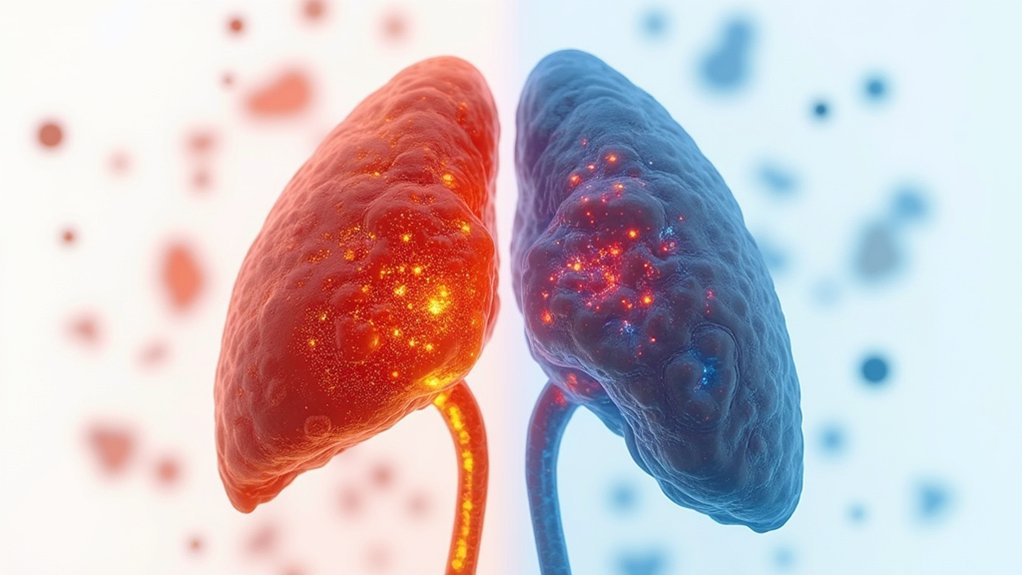
Each type develops through different underlying processes. Regular tolerance develops through neuroadaptation, as your body’s organ systems adjust to repeated drug exposure. Your receptors desensitize, and your metabolic enzymes increase, breaking down substances more efficiently. Reverse tolerance, however, typically signals pathology rather than adaptation. Spotting which drugs cause reverse tolerance helps you avoid unexpected, stronger reactions from smaller doses.
Consider these primary causes:
- Regular tolerance: Receptor desensitization and metabolic enzyme induction reduce drug potency, forcing you to escalate doses.
- Reverse tolerance: Liver or kidney damage cuts enzyme production, so substances like alcohol accumulate faster, raising your BAC.
- Additional factors: Aging, certain medications, health problems, or persistent psychoactive compounds (as with cannabis) heighten your sensitivity.
Recognizing these mechanisms helps you interpret changing responses accurately and safely.
Why is reverse tolerance often more dangerous than regular tolerance
Reverse tolerance is often more dangerous than regular tolerance because it makes you hypersensitive, so even smaller amounts trigger severe reactions. With regular tolerance, you need increasing doses to feel effects, so escalation happens gradually and predictably. Reverse tolerance flips this. This creates two critical risks. First, reverse tolerance signals internal damage, particularly liver cirrhosis, that’s often irreversible. Second, it appears suddenly in long-term users, catching you off guard. You might intoxicate faster than someone who rarely drinks, with tiny quantities causing severe impairment. Reverse tolerance to alcohol shows why tiny amounts can cause surprisingly strong effects, making careful monitoring crucial during recovery.
The clinical danger intensifies because these heightened reactions mimic overdose symptoms. Medical providers may misdiagnose your condition or delay intervention, mistaking sensitization for acute poisoning. Unlike tolerance’s neuroadaptive nature, reverse tolerance flags organ system failure demanding immediate attention.
How Fortify Wellness helps when tolerance changes point to a problem
Fortify Wellness helps when tolerance changes point to a problem by treating altered tolerance as clinical data, not a personal failing. Whether you’re needing more or suddenly reacting to less, that change signals something worth investigating. Because reverse tolerance often reflects organ damage, particularly hepatic impairment, early assessment matters. You’ll receive evaluation that distinguishes neuroadaptation from underlying pathology, guiding appropriate intervention.
Fortify Wellness supports you through:
- Medical assessment, screening liver and kidney function to identify whether reduced metabolism explains heightened sensitivity.
- Substance use evaluation, determining if escalating doses meet DSM-5 criteria for a use disorder.
- Individualized treatment planning, matching care to your physiological findings and severity.
Don’t dismiss a tolerance change. When you act early, you reduce the risk of irreversible damage.
Get Answers About a Tolerance Change at Fortify Wellness
A shift in how you react to a substance is worth checking, especially when smaller amounts start hitting harder. That pattern can point to liver or kidney damage, not just habit. At Fortify Wellness, our team screens organ function, evaluates substance use, and builds a treatment plan around what we find. We offer PHP, IOP, and OP programs in Granada Hills, plus medical and psychiatric support at every stage.
Verify your insurance or call (818) 918-9564. Help is available 24/7 and every conversation is private.
FAQs
Can you have both regular tolerance and reverse tolerance at the same time?
Yes. These patterns can overlap depending on the substance, how long you’ve used, and the state of your organ systems. Someone with a long history of alcohol use might have built regular tolerance for years, then shift toward reverse tolerance once liver function declines. The change in direction is often what signals that something underlying has changed.
Is reverse tolerance permanent, or can it improve?
It depends on the cause. When reverse tolerance stems from liver or kidney damage, improvement is tied to how much organ function can recover, and some damage like cirrhosis is irreversible. This is why early medical assessment matters so much. Catching the change sooner gives you a better chance of protecting whatever function remains.
Does reverse tolerance only happen with alcohol?
No. While alcohol is the most common and clearest example because of the liver’s central role in metabolizing it, reverse tolerance can appear with other substances too. Cannabis is sometimes associated with heightened sensitivity in long-term users, and aging, certain medications, and other health problems can all increase how strongly your body reacts to a given dose.
How do I know if my tolerance change is a warning sign?
Any noticeable shift in how you respond to a substance is worth paying attention to, but a sudden increase in sensitivity, where smaller amounts hit harder than they used to, is especially important to investigate. That pattern can point to organ impairment rather than normal adaptation. A medical evaluation can screen liver and kidney function and tell you what’s driving the change.
Can reverse tolerance cause an overdose?
Heightened sensitivity can produce reactions that look and feel like an overdose, even from amounts you previously handled without issue. Because these reactions can mimic acute poisoning, they can also be misread by others around you or delay the right response. If you’re reacting severely to small doses, treat it as a medical concern and seek evaluation.